
Most clients come to French Polynesia asking for Bora Bora. They already know Mount Otemanu, the overwater bungalow, and breakfast arriving by canoe. What they usually don’t know is where to go from there.
Do they stay in the Society Islands and add Taha’a? Go farther out to Tikehau? Do they need all three, or would two be enough? From a hotel search, the islands can start to blur together. Once you get into what clients will actually do there, they separate pretty quickly.
Taha’a brings vanilla plantations, pearl farms, Raiatea across the lagoon, and a coral garden worth swimming more than once. Tikehau is a different landscape entirely: low coral motu, pink sand, marine life, and a 26-kilometer lagoon out in the Tuamotus. Nuku Hiva drops the lagoon altogether for raw mountain terrain in the most remote archipelago on the planet.
Once Bora Bora is on the table, listen for what else comes up. Vanilla, pearls, and time spent exploring the island point toward Taha’a. A client chasing quiet, distance from the crowds, or open water points toward Tikehau. A client who’s already done French Polynesia once, or who keeps asking about culture and terrain rather than beaches, points toward Nuku Hiva.
Key Takeaways
• Bora Bora pairs naturally with Taha’a for a first trip, or Tikehau for clients drawn to a more remote atoll experience; Nuku Hiva works better as a fourth stop than a first one.
• Room category matters as much as the island; check Otemanu views at Bora Bora and lagoon access at Tikehau before booking.
• Don’t split nights evenly across properties; build the trip around what the client wants and the real Air Tahiti schedule.
Le Bora Bora: Start With the Dream
Bora Bora starts before clients reach the resort.
The airport sits on Motu Mute, out in the lagoon, so Otemanu is already visible across the water when they land. White tiare and plumeria leis are part of the welcome, then the boat pulls away between the small islets that circle the island, the water shifting from clear aqua near the motu to sapphire farther out, with coral, tropical fish, and rays visible below.
Le Bora Bora sits on Motu Tevairoa, about twenty minutes from the airport by electric shuttle boat and five minutes from the Chancelade base on the main island. As the resort comes into view, warm thatched roofs sit low behind the sand, and the overwater bungalows stretch across the lagoon toward Otemanu.
Otemanu Restaurant sits at the highest point of the resort, with the bright lagoon below and the mountain directly across the water. Down on the pontoon, breakfast can arrive a different way: an outrigger canoe pulls alongside the bungalow, and clients stay barefoot on their own deck with nothing else on the schedule.
The resort holds Relais & Châteaux status and has been awarded Two MICHELIN Keys, which is worth mentioning to a client who wants the design and service credentials to back up the view.
Get them into the lagoon by late morning. Le Bora Bora runs its own coral garden and nursery as part of the Biorock program, restoring damaged coral guests can snorkel through directly. From there it’s a short swim or paddle back to Miki Miki for grilled fish or poisson cru.
Beyond the Bungalow
Start with rays in the water, a picnic on a secluded motu, a wave runner loop around the island, or an underwater scooter for anyone who’d rather stay below the surface.
For a full morning offshore, Bora Bora Fishing Charters runs half- and full-day deep-sea fishing trips out of the resort, targeting Pacific Blue Marlin and other big-game species. Don’t feel obligated to fill every day; a swim before breakfast and a few hours on the deck is often the whole point.
Cultural workshops run Monday through Saturday: weaving, coconut demonstrations, pareo tying.
Art keeps appearing as clients move around the resort: sculptures among the palms, paintings along the corridors, pieces inside the restaurants. Near arrival, the Tevairoa Gallery focuses on contemporary Polynesian artists.
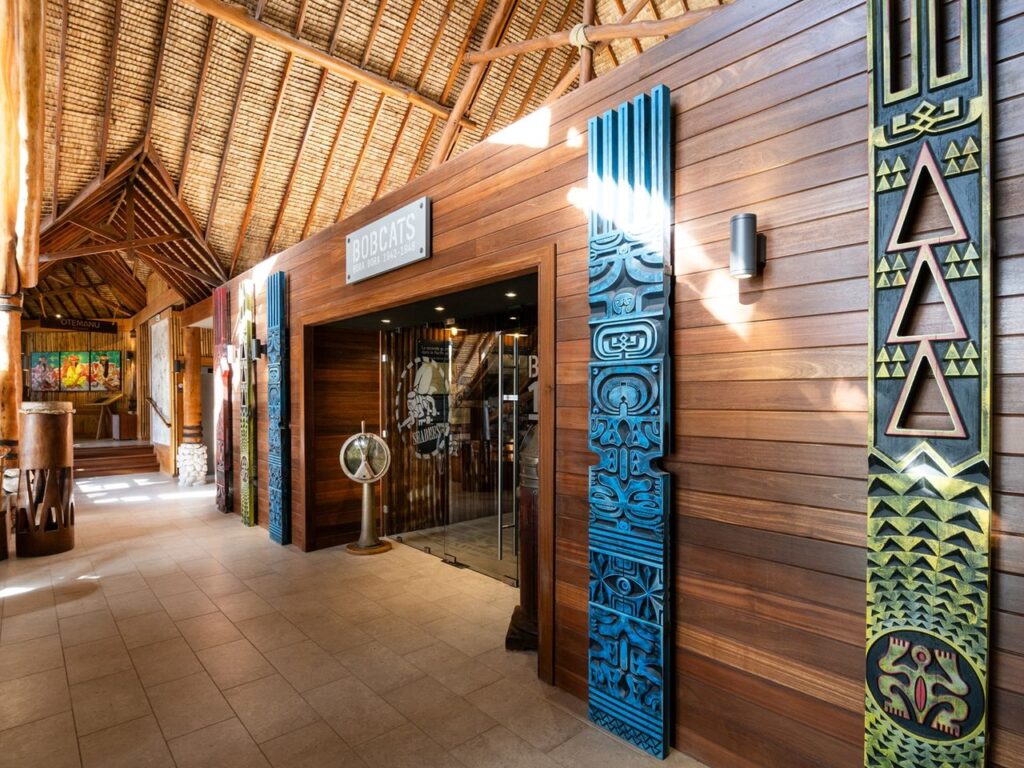
Upstairs from the lobby, the BOBCAT Museum traces the American military presence on Bora Bora during the Second World War, not what most people expect to find between the lagoon and dinner.
Save one evening for the Okeanos Pearl, the resort’s zero-emission solar catamaran, for a sunset cruise around the lagoon. By then, clients have seen the mountain from the restaurant, the beach, and probably from bed, but it still looks different from the boat.
Choosing the Right Bora Bora
For rooms, start with the view. If Otemanu is what the client has been picturing for years, the category actually has to deliver it.
The lead-in Overwater Bungalows already put guests above the lagoon with direct water access and glass at the foot of the bed. Move up to an Otemanu Overwater Bungalow for a guaranteed mountain view, a Pool Overwater Villa for the same view plus a plunge pool, or the End of Pontoon Suite for more space and separation at the far end of the pier.
Don’t default every Bora Bora client to overwater. Beach Villas with Pool put sand right outside the door; Garden Villas with Pool sit further into the property with their own enclosed garden. Both take a rollaway bed, which the overwater categories can’t, making them the better fit for families with more than one child.
Le Taha’a: Give Them More to Notice
Taha’a has no airport of its own. Clients land on Raiatea and cross the shared lagoon by boat to Le Taha’a’s private islet, Motu Tautau, watching the island turn greener as they get closer, with Bora Bora still visible far across the water.
The resort was the first Relais & Châteaux member in French Polynesia and has since added Two MICHELIN Keys, credentials worth mentioning alongside the scenery for your client who regonizes these honors.
The overwater honeymoon is here too, with the same deck, lagoon, and easy swim before breakfast as Bora Bora. What sets Taha’a apart is what’s waiting on land.
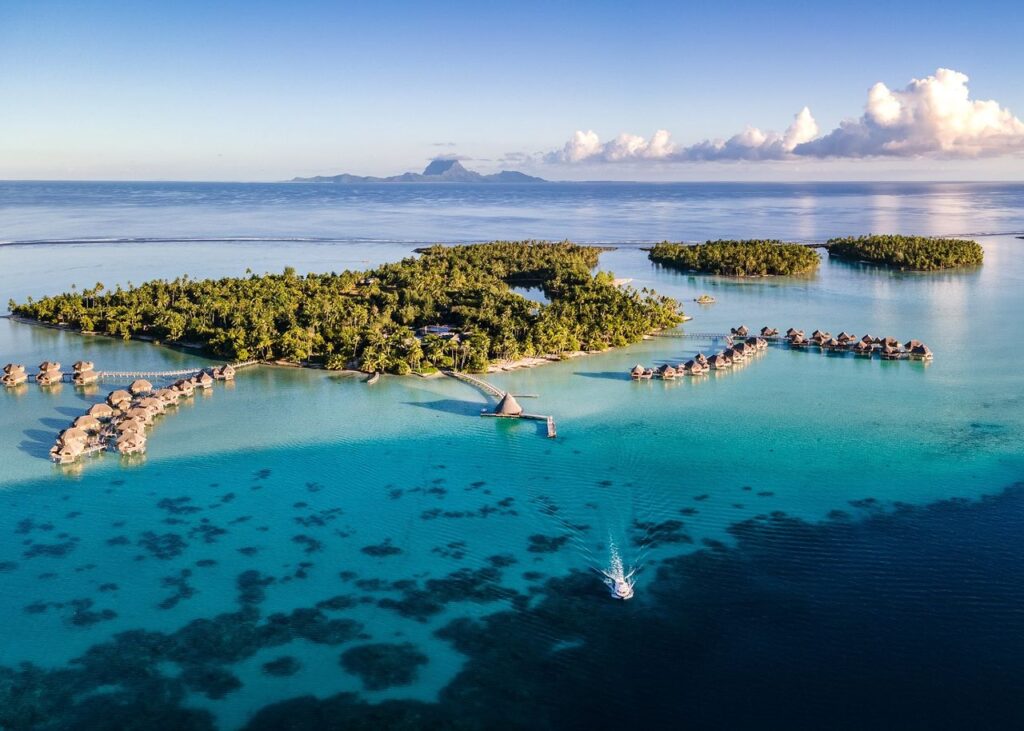
A Day Ashore
Give it at least one full day ashore: a route through the pearl farm and into Taha’a’s Vanilla Valley, where the vines grow under shade, continuing further inland to Domaine Pari Pari.
“Vanilla Island” makes a lot more sense once a client has seen the vines in person, and the vanilla shows in the kitchen and at the resort’s ice cream parlour. At the pearl farm, guests see how the pearls are cultivated in the lagoon before they ever reach the boutique. Further inland, the Vaima’i archaeological site adds a stop for clients who want more of the island’s history alongside the scenery.
Hawaiki Nui, the resort’s treetop restaurant, serves breakfast and dinner with the gardens and lagoon below, an old V6 racing canoe hanging overhead as part of the room’s Polynesian art collection.
Around the Lagoon
The coral garden sits right beside the resort, close enough that snorkeling never has to be a half-day adventure. Guided outings go deeper into the reef for guests who want a naturalist alongside them, and the resort runs its own coral-propagation program as part of its reef restoration work.
Le Taha’a also builds its whole identity around Polynesian art and culture, not just a single excursion: sculptures, carvings, paintings, and installations from local artists run throughout the property as a key part of the stay, worth mentioning to culture-forward clients even without a separate tour booked.
Keep Raiatea in the conversation for a slower day: a guided tour crosses the shared lagoon to explore the Faaroa River, the only navigable river in French Polynesia, before continuing to the sacred Marae Taputapuatea, a UNESCO World Heritage Site.
Raiatea excursions can be booked directly through UJV, as we work closely with their on-site concierge, which offers flexibility for which day that happens rather than locking it into a fixed itinerary.
Choosing the Right Room
For rooms, direction matters as much as category.
Taha’a Overwater Suites look toward the island itself; Sunset Overwater Suites face west toward open ocean and evening light; Bora Bora Overwater Suites look across the coral garden toward Bora Bora in the distance.
Pool Beach Villas put guests on the sand instead, with a private garden, gazebo, and pool.
Le Taha’a works especially well for the couple who arrives ready to do nothing and, two days in, starts asking where the vanilla comes from and what’s happening across the lagoon on Raiatea.
Le Tikehau: Out Into the Atoll
Tikehau barely rises out of the Pacific.
The atoll is a crown of coral islets around a 26-kilometer lagoon, pink sand along the water, with land so low in places that the horizon nearly disappears between lagoon and sky.
Clients land on Tikehau, take a five-minute shuttle to the pier, and cross the lagoon by boat for another fifteen minutes to reach the resort’s private motu, Tianoa.
Just 29 bungalows and suites sit here, which is part of the draw: this is the smallest, quietest property in the collection.
Into the Lagoon
This is the property for a client who wants real distance from the more-traveled islands, not necessarily the one who’s finishing breakfast already asking where the dive boat is going.
Snorkeling stays close to the resort, kayaks move out across the shallows, and the dive boat runs out to deeper water for the marine life Tikehau is known for.
For the food-led client, the Longline Fishing & Picnic excursion has guests fish the lagoon, then brings the catch ashore to be prepared for a picnic on the motu. A separate boat trip crosses the lagoon to Bird Island, home to red-footed boobies and terns.
For a slower afternoon, send guests to Tāvai Spa for a Taurumi massage, the traditional Polynesian treatment built around monoï, tiare flowers, and locally sourced ingredients.
Dinner stays close to the water too: Te Reka Ika runs on the day’s lagoon catch, and Poreho looks directly out over the lagoon with Polynesian and European cooking side by side.
Build an evening around the Fisherman’s Village: six-meter observation towers for stargazing, and a crescent-shaped amphitheater where a storyteller shares Polynesian legends and the old practice of celestial navigation.
Choosing the Right Room (and Knowing the Water Access)
For overwater rooms, check direct lagoon access before anything else.
The lead-in Overwater Bungalows sit above a hoa, a shallow opening in the coral crown, with a glass floor for watching fish below, but no direct lagoon access from the room itself.
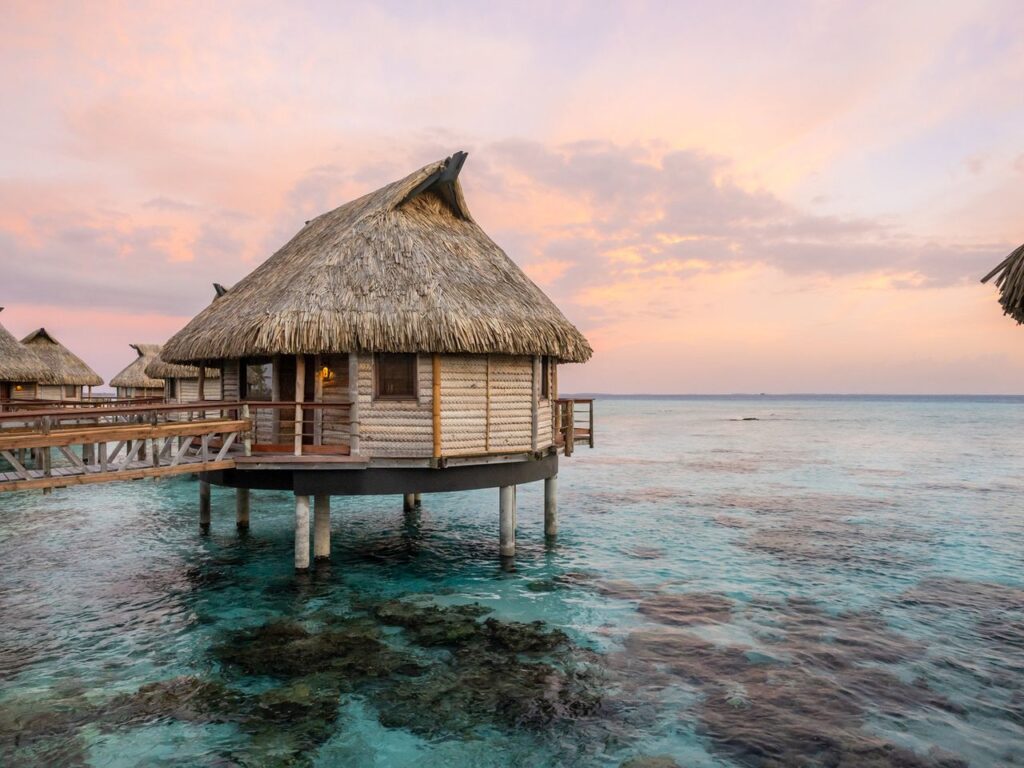
The Premium Overwater Bungalows, End of Pontoon Overwater Bungalows, and the larger Overwater Suites all have direct access to the water. Beach Bungalows put guests under the coconut palms with pink sand and direct lagoon access, and are worth leading with for families.
Flag the transfer for guests with reduced mobility before booking: getting from the airport to the resort includes a boat ride, and the boats aren’t equipped with ramps.
Tikehau suits repeat French Polynesia travelers and first-timers looking beyond the usual island circuit: pink sand, a private motu, a wide lagoon, marine life, and very little between them and the horizon.
Le Nuku Hiva: When There’s No Lagoon at All
Nuku Hiva doesn’t try to be a beach resort. It sits on a hillside above Taiohae Bay, on Nuku Hiva itself, the largest island in the Marquesas and the archipelago’s administrative capital, more than 900 miles northeast of Tahiti in what’s considered the most remote archipelago on the planet.
There’s no lagoon here, and that’s the point for the right client.
Twenty bungalows sit on the hillside, decorated with hand-carved details and tapa cloth from local Marquesan artists, each with its own terrace looking out over the bay. A short walk downhill leads to Taiohae’s black sand beach and village, close enough for an afternoon without planning around it.
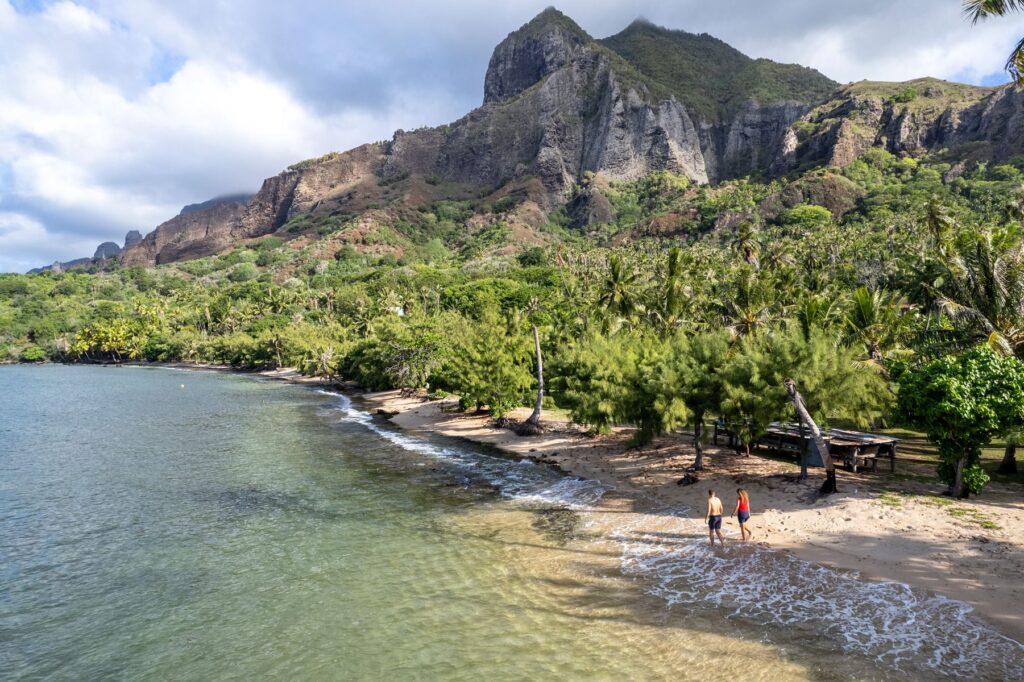
Local legend holds that each Marquesan island was once a piece of a house, and Nuku Hiva was the roof.
The terrain backs that up: the Hakaui waterfall drops nearly a thousand feet, and wild horses, goats, and boars move freely across land most French Polynesia visitors never see. An infinity pool overlooks the bay for anyone who still wants to swim, and the resort offers free bicycles and carving classes for guests who want to stay closer to home.
This is a Relais & Châteaux property, and it’s built to stay unpretentious rather than polished, in keeping with the Marquesan way of life rather than competing with the lagoon islands on their own terms.
Nuku Hiva suits the client who has already done Bora Bora, Taha’a, or Tikehau and is ready to trade the lagoon for black sand, mountains, Marquesan culture, and days that have very little to do with an overwater bungalow.
How to Build the Islands
Not every client needs all four properties.
For a first trip built around Bora Bora, pairing it with Le Taha’a works naturally: give guests Otemanu and the overwater morning they came for, then move them somewhere vanilla, pearls, reef, and Raiatea fill the days.
Pairing Le Bora Bora with Le Tikehau instead changes the scenery far more dramatically, opening with one of French Polynesia’s most recognizable volcanic landscapes and closing on a coral atoll that barely rises above the sea. That combination works well for guests who want Bora Bora but keep steering the conversation toward marine life, open water, and somewhere less familiar than the usual French Polynesia route.
Le Taha’a and Le Tikehau together suit repeat visitors, or first-timers who were already looking past Bora Bora: Taha’a gives them plenty to do on land, Tikehau takes them further into the water.
Le Nuku Hiva sits apart from the other three, both geographically and in what it offers. It’s rarely a client’s first Pearl Resorts stop, since there’s no lagoon and the flights add real time to the trip, but it’s a strong fourth stop or standalone add-on for a client who’s already covered the lagoon islands and wants terrain, culture, and distance from everything else instead.
Three or four islands can work too, but every transfer should earn its place. Don’t split the nights evenly just because there are multiple resorts on the table; give more time to whichever property matches what the client is actually chasing, and build the routing around the real Air Tahiti schedule rather than a prettier order on paper.
Why Build It With UJV
Bora Bora is the easy part of the French Polynesia conversation. Most clients already know why they want to go.
What comes after Bora Bora takes more thought.
At Le Bora Bora, know when to leave the day open and make sure the room gives the client the view they came for.
Le Taha’a gives curious clients plenty beyond the bungalow: vanilla plantations, pearl farms, the coral garden, Raiatea, and food.
For Le Tikehau, know the atoll. Know why the hoa matters, which overwater categories have direct lagoon access, and whether the client cares more about the bungalow, the marine life, or simply being somewhere few reach.
And know when a client is actually ready for Nuku Hiva instead of another lagoon stop.
With Pearl Resorts, the properties stay within one collection while the trip changes completely: from Otemanu’s overwater mornings to Taha’a’s vanilla and reef to the low coral atolls of the Tuamotus to a mountain lodge above wild horses in the Marquesas.
UJV can help put the island, room, routing, and experiences in the right order.
FAQs: Planning a Pearl Resorts Trip
Do clients need to visit all four Pearl Resorts properties?
No. Two properties is often the stronger trip. Bora Bora pairs naturalor with Tikehau for a client who wants Bora Bora plus real distance from the crowds — a strong dive and snorkel base too. Nuku Hiva is usually a later addition, for a client who’s already covered the lagoon islands and wants something farther out.
How long should a Bora Bora and Taha’a itinerary run?
Enough time on each island to actually use it. Bora Bora supports a shorter, activity-light stay built around the view and the lagoon. Taha’a rewards at least one full day ashore for the vanilla and pearl excursions, plus time in the coral garden, so it’s worth weighing the nights toward whichever the client is more excited about rather than splitting evenly.
Which Bora Bora room category has the best view of Mount Otemanu?
The Otemanu Overwater Bungalow guarantees the mountain view. The Pool Overwater Villa gives the same view plus a private plunge pool, and the End of Pontoon Suite trades a guaranteed Otemanu view for more space and privacy at the far end of the pier.
Which Le Tikehau room categories have direct lagoon access?
The Premium Overwater Bungalow, End of Pontoon Overwater Bungalow, Overwater Suite, and Beach Bungalow all have direct access. The lead-in Overwater Bungalow does not, since it sits over a hoa where the coral and current make direct access impractical.
Is Le Taha’a good for families?
It can be, with the right room category. Land-based villas fit families better than the overwater suites; ask about current room-specific occupancy and bedding options before booking.
Is Le Nuku Hiva a good first stop in French Polynesia?
Usually not. It’s a strong fourth stop or standalone trip for a client who’s already experienced the lagoon islands and wants something different, culture and terrain rather than overwater bungalows, but the flight time and lack of a lagoon make it a hard sell as someone’s introduction to the region.