
Most Italy itineraries point north. Rome, Florence, Venice, maybe a stretch of the Amalfi Coast if the client wants water. It’s a proven circuit that sells itself.
It’s also the version most well-traveled clients have already done.
Southern Italy is the version they haven’t. Puglia sits in the heel of the boot, all whitewashed towns and olive groves running down to the Adriatic. Basilicata sits just inland and west of it, holding two places that look nothing alike: Matera, a city carved into stone over thousands of years, and Maratea, a cliffside town on the Tyrrhenian where a marble Redeemer watches the sea.
Put together, they make one itinerary that moves through three completely different landscapes without ever repeating itself. We know it works; we ran this exact route: seven days from the Itria Valley to the Maratea coast. Here’s how to understand it, sequence it, and sell it.
Part One: The Itria Valley and Borgo Egnazia
The first half of the trip lives at Borgo Egnazia, in Savelletri di Fasano on the Puglian coast. It’s the property that put luxury Puglia on the map: a village-resort built to feel like a traditional Puglian borgo, with ivory stone, shaded courtyards, and a central piazza that comes alive in the evenings.
Rooms range from doubles in the main Borgo to private cassettes and villas that sleep a group. The light does most of the work, turning everything around you into a warm dusk by late afternoon.
Clients can fill days here without leaving the gate. Four pools and a beach club. Complimentary bikes for rides through the olive groves. The Vair spa, with its wet area and treatment rituals, plus a gym, tennis and padel courts, a small working farm for younger travelers, and Bottega Egnazia for Puglian crafts worth taking home. The San Domenico golf course runs along the Adriatic next door.
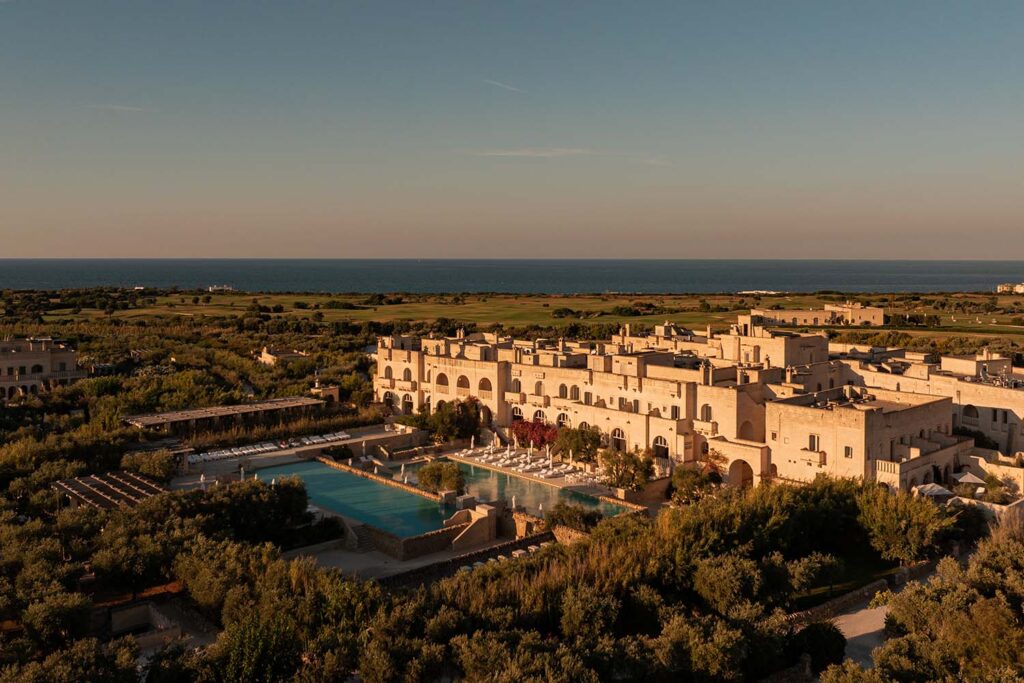
The first dinner sets the tone. A welcome dinner at Masseria San Domenico, the Melpignano family’s adults-only 15th-century masseria, set among century-old olive groves with its own seawater pool. Later in the stay, an open-air dinner in the Piazza at Borgo Egnazia itself, and lunches from the beach club to the resort’s own restaurants.
And there are plenty of those. Borgo Egnazia offers an authentic journey through the flavors of Puglia, with eight distinctive restaurants celebrating the region’s rich culinary heritage through a contemporary lens.
From the Michelin-starred Due Camini to traditional trattorias, beachfront dining, a classic braceria, and a pizzeria, every venue showcases the finest seasonal ingredients, exceptional olive oils, fresh seafood, and locally sourced produce, delivering a true taste of Southern Italy.
Three nights is the right amount of time here. Enough to use the property fully and still get out into the region.
A Full Day Across Puglia, by Vintage Car
This is the day that sells the whole trip, and it’s worth leading with when you pitch it.
The morning starts at the main arch with a row of classic Italian vintage cars. From there the route crosses the Itria Valley, which is the most evocative way to see this part of Puglia and a far better story than a coach transfer. This is what clients remember most: the private walkthroughs, the table held at the winery, the after-hours guided descent into the caves. This is what it’s all about.
The route threads together three very different stops.
Alberobello comes next, the UNESCO-listed trulli district with its cone-roofed stone houses. The cars stay parked for this one, traded for a walking tour with Mimmo, a local guide who tells the district’s history through the kind of anecdotes you only get from someone who grew up with it. It keeps the most photographed corner of Puglia from feeling like a quick photo stop.
A winery near Martina Franca serves a light, local lunch built around the flavors of the valley. The host, Giovanni, is a winemaker who spent years working around the world before coming home to revive a historic vineyard near the Valle d’Itria, including the old vines once used to make the famous Vermouth Martini. He pours what he makes and tells the story as he goes, the kind of unhurried hour where the wine, the land, and the person behind it line up.
The Castellana Caves conclude the day with a guided descent offering exclusive access more than 60 meters below the surface, into one of Italy’s most spectacular karstic cave systems, carved over tens of millions of years. It’s the kind of contrast that makes an itinerary memorable: trulli and vineyards above, an ancient cave network below, all in an afternoon.
Where Puglia Meets the Adriatic
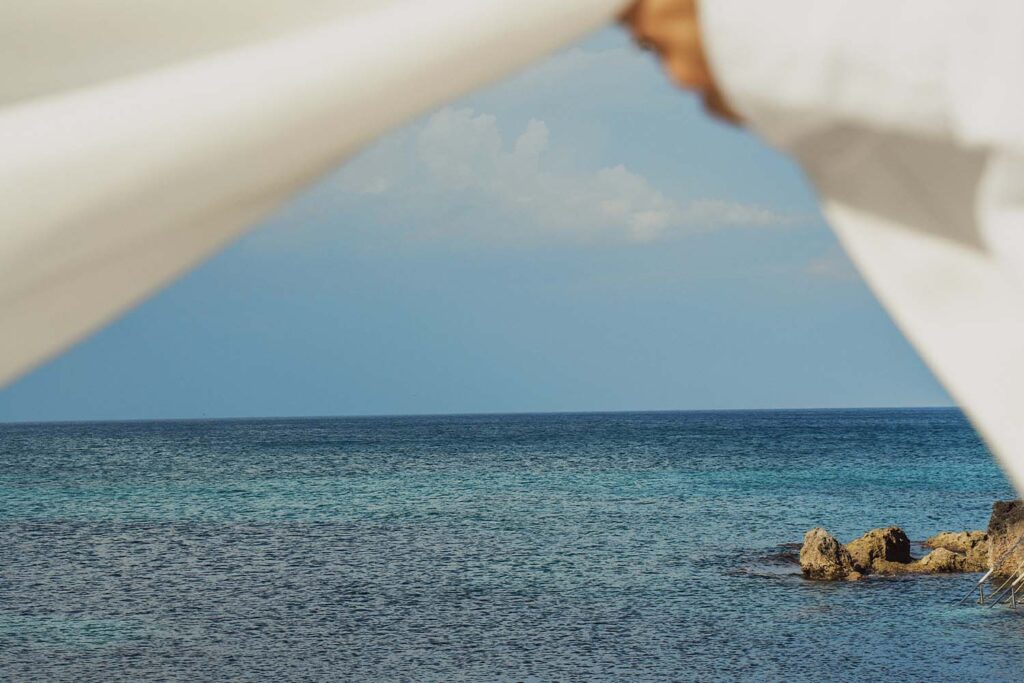
One day belongs entirely to the coast, and it’s the easiest one to sell to clients who think they’ve seen the Mediterranean.
It opens with “Domenica al Mare” at Cala Masciola Beach Club, a buffet lunch with live music right on the water. In the afternoon, guests board a boat in the fishing village of Savelletri and push out along the Adriatic toward Monopoli, past limestone cliffs, secluded coves, and crystal-clear waters.
As the sun starts to set, a curated aperitivo comes out, regional bites and a cold drink in hand, the whole coastline going gold and slowing down with you. At the right time of day with the perfect current, the route can continue toward Polignano a Mare.
It’s a low-effort, high-payoff afternoon. Nobody plans much, and everybody remembers it.
Part Two: Matera, Carved from Its Own Silence
Here’s a detail worth knowing before a client asks: Matera is not in Puglia. It’s in Basilicata, the next region over, about an hour-and-thirty-minute drive inland from Savelletri through the Murgia highlands. People conflate the two constantly. Getting it right is a small thing that makes you sound like you’ve been.
Matera is one of the oldest continuously inhabited settlements on earth, lived in for around nine thousand years. The Sassi, the cave dwellings stacked into the ravine, were named a UNESCO World Heritage Site in 1993 and carried the city to its turn as European Capital of Culture in 2019. It has stood in for the ancient world on screen more than once, most recently in the James Bond series, though no frame does the place justice the way standing in it does.
The stay is at Palazzo Gattini, a centuries-old noble palazzo at the top of the Sassi overlooking the Piazza Duomo. It’s an intimate luxury set directly in the ancient stone, not a modern hotel looking out across the ravine.
The experience to build around is the walking tour, timed for the most cinematic hour of the day. As the sun drops, the limestone turns amber and the cave-houses glow. The surfaces are uneven, so this is a proper-shoes appointment, and it’s the kind of hour clients describe for years afterward.
Dinner stays underground in the best way, at Retrobottega, a contemporary restaurant set inside a cave. The cooking is regional and served small-plate style, paired with a deep list of local wines, the modern and the ancient in the same room.
One night anchors Matera inside this route. It’s the hinge between Puglia’s whitewashed coast and the cliffs ahead.
Part Three: Maratea and the Tyrrhenian Coast
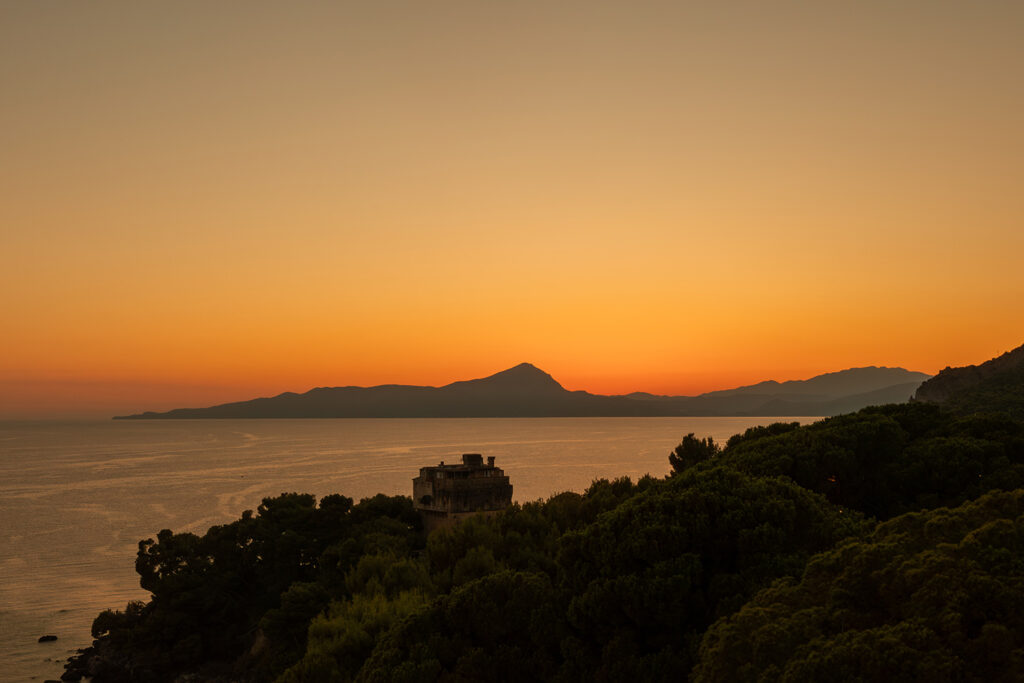
The third act crosses Basilicata to its other coastline, the Tyrrhenian side, and the discreet glamour of Maratea. They call it the Pearl of the Tyrrhenian, and the name earns itself the moment you see the coast: limestone cliffs, hidden coves, and a marble Christ the Redeemer standing twenty-one meters tall on Monte San Biagio above the Gulf of Policastro.
The base is Hotel Santavenere, a historic villa-hotel set on ten hectares of Mediterranean gardens with private beach access. Twenty-six rooms, sea on one side, olive groves on the other. After Matera’s stone, the green and the salt air land as a deliberate exhale.
The signature morning is the guided hike up to the Redeemer, an ascent that opens onto panoramic views over the gulf. Comfortable shoes, and then the rest of the day slows down.
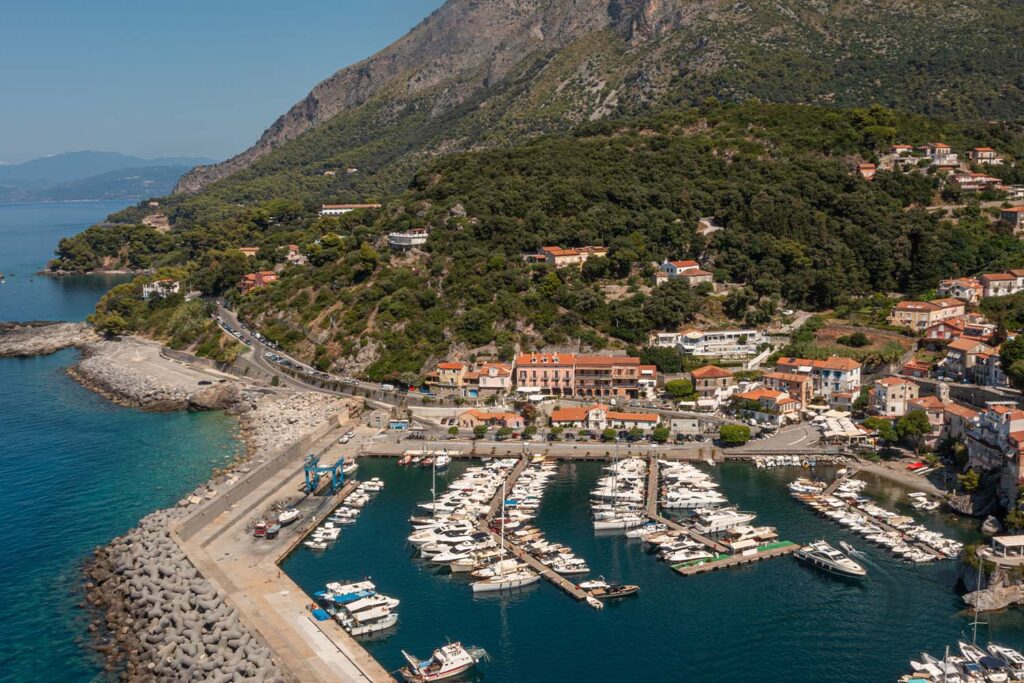
Le Lanterne is Hotel Santavenere’s gourmet flagship, the right room for a farewell dinner over the sea. Gli Ulivi handles the daytime version, a light Mediterranean lunch among the olive trees.
Out in the countryside, Agriturismo Casale De Filippo is the other side of Lucanian food entirely: a family-run farm where the produce, the olive oil, the wine, and the region’s prized Suino Nero Lucano all come off the land around the table.
There’s also a hands-on mixology session with the head bartender, working with Mediterranean botanicals, an easy add for groups who want something interactive on the last full day.
Two nights close the trip the way it should: slow and coastal.
How to Sequence and Sell It
The order of this trip is your whole strategy, and this route runs in the right direction.
It’s intentionally structured to move from the whitewashed towns and olive groves of Puglia, through the ancient stone of Matera, and out to the cliffs and open sea of Maratea. This offers three contrasting landscapes, each increasing in visual and experiential impact, and deliberately concludes on the coast. Clients leave with the Tyrrhenian as their last memory, which is exactly where you want a trip like this to end.
A few practical notes for positioning:
- Timing. Build it for late spring or early fall. The shoulder seasons (roughly May to June and September to October) offer the best weather without the peak-summer crowds in Matera and along the coast.
- Length. Seven nights cover it comfortably: three at Borgo Egnazia, one in Matera, two in Maratea, with the travel days built in. Trim or extend from there.
- Effort. Most of this is easy going, with one exception you should set expectations on: the Maratea trek to the Redeemer is a moderate climb that takes roughly three hours, best suited for those prepared for a more active morning. Alternatively, guests can drive partway and enjoy panoramic views from accessible vantage points.
- Gateways. Bari is the practical gateway for the core route, about an hour from both Savelletri and Matera. We coordinate the private transfers throughout.
An Extended Trip: Rome & Naples
For those who can give Italy more than a week, two major gateways sit close enough to fold in without doubling back.
Rome can be a starting destination. It’s easy for international arrivals, with a few days in the capital before heading south, and a short hop down to Puglia from there.
Naples is a perfect end. Maratea sits within reach of Naples along the Tyrrhenian coast, making the city a convenient exit point and a chance to end on one more arrival rather than retracing the route. Start in Rome, end in Naples, and the whole trip becomes one continuous arc instead of an out-and-back.
It’s also worth recommending an extra night if your client has the time. One night in Matera anchors the trip, but a second night will allow travelers to actually live in the Sassi, catching both the amber of the evening walk and the quiet of early morning before the day-trippers arrive.
Put together, an extended trip might run:
- Three nights in Rome
- Three nights at Borgo Egnazia
- One to two nights in Matera
- Two nights in Maratea
- One night in Naples
That’s two world cities bookending three southern landscapes, a one-way arc with no backtracking, and room to breathe in the middle. It’s for those who want a whole trip through Italy, not just a single region, and this is the easiest way to turn a focused southern route into a full national itinerary.
Who This Trip Is For
This Southern Italy itinerary is designed for experienced travelers who have already explored the Rome-Florence-Venice circuit and seek a part of Italy that remains undiscovered by most.
It appeals to those looking for fewer crowds and richer regional character, where ‘somewhere new’ represents a truly distinctive experience rather than simply another hotel along a familiar coastline.
This also works beautifully for milestone couples, with cliffside dining in Maratea and cave-side stays in Matera.
It works for culturally curious travelers who want UNESCO sites they can actually walk through, not just photograph.
It’s made for the off-the-beaten-path traveler who wants a real, lived-in Italy rather than a polished version of the same few cities.
And it works for food-led groups, between the masseria dinners, the winery lunch, the cave restaurant in Matera, and the farm table in Maratea.
The qualifying question is this: Does the client want Italy, or do they want the Italy most travelers never reach?
Why Build It With UJV
The standard Italy trip is easy to build and easy to sell.
This one asks for a little more upfront: a client who’s ready to look past Rome and Venice, and it gives them something the famous circuit can’t.
The arc is what makes it hard to replicate. Whitewashed towns and olive groves in Puglia, the ancient stone of Matera, the cliffs of Maratea: three landscapes that look nothing alike, run in the right order, ending on the open sea. The stays hold it together.
Borgo Egnazia, Masseria San Domenico, and Hotel Santavenere are current, full of character, and worth recommending with confidence. The experiences in between, the vintage-car day across the Itria Valley, the sunset boat to Monopoli, the Sassi at golden hour, are what the client comes home talking about.
Position it when someone has done Italy and wants the part they missed. When “somewhere new” has to mean genuinely new, not a different hotel on the same coast.